
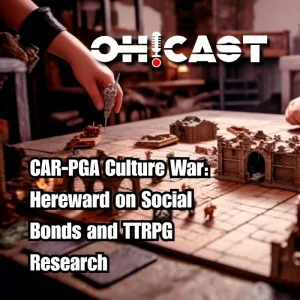
The CAR-PGA Culture War: Leaving Twitter for Blue Sky
Mike Truska, host and current committee chair for the CAR-PGA, welcomes everyone to the virtual session. He begins with crucial housekeeping notes, including welcoming new members Adam and Hugh. They quickly move the discussion to serious matters, including the recent decision to leave Twitter/X. Mike explains that many reasons prompted the move; the membership was “under attack” was not the least of them. A published book, which became the central storm around a ridiculous CAR-PGA Culture War, caused this. Mike notes the situation was a clear sign it was time to leave. Consequently, the organization has adopted Blue Sky. This is paying dividends by helping the CAR-PGA find a new audience and share monthly newsletters. He stresses that strength in numbers is important to activate the CAR-PGA base against these attacks and navigate the CAR-PGA Culture War.

Herward’s PhD Research on TTRPG Relationships
Mike is thrilled to introduce guest Herward (Herward Proops), a member who is also a psychotherapist and PhD researcher. Herward shares his origin story, detailing how he got into tabletop role-playing games (TTRPGs). As a non-competitive kid, he loved imaginative play. He started with A D&D Second Edition after reading David Gemmell’s Waylander. After drifting away, he returned to TTRPGs during the 2020 COVID lockdown, a common experience for many.
Herward’s PhD research focuses on how TTRPGs’ co-creative nature builds positive social relationships. The germ of the idea came when a new player assumed the group had been lifelong friends, but they had only met through the online campaign. Therefore, he is studying the psychological safety and rapid bonding created by working through fictional challenges together. Herward’s current methodology involves observing face-to-face and online groups. They follow this with interviews to analyze the dynamics through the lens of Carl Rogers’ therapeutic relationship theory.
CAR-PGA Housekeeping and Future Plans
Before the interview, Mike also reminded members about the upcoming board vote. The CAR-PGA always seeks new board members to ensure healthy turnover. Submissions will open in January for the February vote. He emphasizes that the CAR-PGA embraces diversity and inclusion. This philosophy is becoming more critical to uphold as the organization goes forward, especially in the wake of the recent culture war.
Full Transcript Outline (Quick Jumps)
Full Transcript
Mike (00:35.406)
Welcome everybody. My name is Mike Truska. I am your host and current committee chair for the RPGA. is December. As promised, we are continuing our streak of keeping these virtual sessions up and running. I’m so excited that we’re able to do that. It’s taken a lot of planning and a lot of patience and the part of several of our folks who we’ve scheduled in advance, month in advance.
So I’m very excited to continue to do that and round out the year and finish strong. A couple of housekeeping notes before we get to our guest. First is I’d like to welcome two new members, Adam and Hugh. Both just recently joined, one at the end of November, Hugh in the beginning of December, which is great. And we’re very excited to see that. Hugh joined us from Blue Sky. Some of you have seen this. If you haven’t, you’ll be hearing from me in the letter.
I have left Twitter slash X as it’s called now for lots of reasons, not the least of which our membership as far as I’m concerned was under attack. For some of you know, there is a book that was published and it was sort of a central storm around essentially culture that was ridiculous. The whole thing was ridiculous, but long and short of it is that was definitely a sign that it was time to go.
and blue sky is a new start for all of us, but it’s actually paying dividends. We’re finding a new audience, which I’m very excited about. We actually have a car PGA, list of all our members. So if you are on blue sky, please connect with me. Number one and number two, I will add you to that list and I will be sharing that list, to help, bring in new members and, raise awareness of what we’re doing more to the point. We’re sharing the monthly newsletters there as well. And that’s already paid dividends just trying once, which I was very excited about.
We are also coming up at the end of the year. So you know what that means. It’s going to be time to vote for the board. And just as a reminder, the board chooses the chair, which is the role I’m currently in. So it’s sort of a combination of steps. We were actually thinking about this. We did have a board meeting. We had a board meeting yesterday, believe it or not. And we were trying to go over exactly why we don’t do it right away. And that’s because we realized in January is when we give people about a month to submit themselves for the board.
Mike (02:55.916)
And then in February, we vote for those board members. So this is a request. We have almost 60 members. We don’t want it to be the same people every year. We think board turnover, including my role, is good and healthy. So by all means, please, please, please consider submitting yourself for the board. And then, of course, then there’s voting, and then we can vote. So if we can have up to five members, which I think is a good number, we sort of went over that.
As to why we have five board members, but it prevents stalemates. You don’t want three. That’s too much. That’s sort of too much power in with a select group. So five sort of is a really magic number for that. So we think that would be great. You will hear more in January. And we will absolutely then take it from there and continue to the hopefully a new 2025. However.
It’s about to get difficult for the car PGA. the car PGA as a organization obviously embraces diversity and inclusion. we embrace the philosophy that gamers all over the world should be able to game no matter who or what they are. that discussion for those of you who joined, faith and I, when we talked previously and faith is now a member. So welcome faith, is very critical and is going to only become more critical as we go forward. So,
It’s easy to talk about diversity inclusion when everybody’s saying it, which is when we started doing it. It is not as easy when you start to come under attack. And I think the situation in Twitter was a perfect example of that. So more to come. We will be talking about that a lot and sort of what we can do. But I think the answer is strength in numbers. We need to activate our CarPGA base. If I’ve learned anything from my fascinating experiments and new friends on Blue Sky, it’s that the more we’re together,
the more powerful we are. So I’m hoping we see more of that. All right, that was very serious. So I’m excited to introduce Herward, Herward-Prupes. I’m hopefully saying it, Herward, that’s right. I got it this time, I practiced. Herward, I’m thrilled. You’re a member, so you’ve been a member for a bit. And we finally decided this would be a good time.
Mike (05:08.462)
to have you share, you had some research going on. So the timing worked out, which was great. You’ve been very tolerant. As I always say, I’m always thrilled when folks can stick with us because this is quite a bit of a timeframe. So, you were really, really tolerant. I really appreciate that. So welcome. I’m super excited to have you.
Yeah, it’s wonderful to be here. I’m really excited to have a chat.
So, though you’ve seen this before, because you’ve been on some of our chats. One of the things we like to do is just basically do the, always, I think I, I don’t know if I mentioned this, I thought this was really unique. And I listened to the dragon podcast and I know Shelley Mazenobel I’ve known her for years and I was like, she does the same thing. not, it’s not that, not that new, her point, it certainly works, which is simply you’re taking people through your sort of gaming, experience. Cause we all start there. Right? So we’d love to hear how you got into the, into the.
gaming tabletop role playing games. What drew you to the hobby? And then we’ll talk more about how that progressed into your what you’re doing today. But if you could like start there, I think that would be great.
Yeah, I was saying earlier, before we started recording that this is a really a question weirdly that I should have thought about. I’m a psychotherapist and I’m doing kind of research into these games. I’m like, why did I never think about how I got into these games and what drew me to these games? There’s a big gap there. So it was great to do this. I think I’ve always been into imaginative kind of make believe play. I’m not very good at sports.
Hereward (06:38.638)
I’ve got very poor hand-eye coordination when it comes to kicking balls and catching things and stuff and along with that I’m pretty non-competitive. I don’t really have a really, you know, that killer instinct to win and stuff like that. So as a kid, when I was a little kid, I was always playing imaginary games and dressing up as different characters. A favorite family story is when I was about two years old, I was at…
We were living in Canada at the time and I was going to like a kindergarten or a nursery of some kind. But that day my mum had made me a mask, an elephant mask using like toilet rolls for the trunk. But apparently I was like totally immersed in the character. I was an elephant and I wasn’t taking that mask off for anyone. Apparently I didn’t drink all day. I didn’t eat all day. By the time I came out the nursery I had this like red mark from weather.
The cardboard toilet tube had like rubbed on my nose. I was an elephant. And yeah, I think I’ve always been into kind of imaginative games. And then as I got a little older, I got really into video games. And I remember vividly one weekend, I can’t remember what I did. I was about 13. It must have been something bad because my Mega Drive, my Sega Genesis, as you guys call it in the States, was a crazy game. I was grounded. I didn’t have my Mega Drive. I was grounded. I didn’t have anything to do that weekend.
But fortunately, a pal of mine at school, a guy called Ruben, I told him I was grounded and couldn’t go out that weekend. And he reached into his bag and he gave me a copy of David Gemmell’s Waylander. I don’t know if you’ve ever read Waylander. It’s my favorite fantasy novel still to this day. And it was one of the best weekends of my life. I sat and read this novel cover to cover in my room. I wasn’t allowed to do anything else and completely fell in love with fantasy fiction.
And it was really only a few weeks after that, I was talking about Waylander to a family friend who was four or five years older than me. And he said, if you like that, you’ll love Dungeons and Dragons. And I was like, what is this? So he introduced me to the game. And obviously, my age, was AD &D second edition that I cut my teeth on and I completely fell in love with it. mean, head over heels. was like, this is…
Hereward (08:59.47)
this is the sort of play I like and the sense of kind of creativity and freedom, but also the sort of possibilities for social interaction and how, you know, you do stuff with people. I just loved. So from about 13, 14 years old till I was about 17, 18, that was my thing. I played AD &D.
Ask Magica, Cyberpunk 2020, Whispering Vault, Vampire the Mass Grave, Vampire the Dark Ages.
There was a stage in gaming, which is hard to imagine, I think, where first you played D &D and then you played everything. I certainly was the same, which was there were just so many games coming out. Everybody was sort of open to it. think now it’s actually different because there’s different levels of visibility and publicity. And frankly, there’s probably a million tabletop games now. But back then they were new and it was exciting. And you sort of jumped from each one just to try it to see. And every game you mentioned, certainly a lot of
gamers at least my age have tried, right? Said, what a great idea. Let’s see this. And we didn’t necessarily stick with it, but we certainly tried. And I know there’s definitely groups that that’s how they diverged, right? That was their, they were the Dungeons and Dragons era was over and they sort of went off in that direction, which is great. So take us through then how that bridge to academia, therapy, tabletop role playing. Clearly there was sort of a convergence at some point, but how did that happen?
It’s quite interesting. actually, my first degree was probably the last time I played role playing games was maybe about 19 or something. And then, you know, I have to say I sort of drifted away from role playing games. And it was actually only in the lockdown during COVID time. And this is a really common experience. I know I’ve spoken to several people.
Hereward (11:02.808)
who said the same thing, it’s something they used to do when they were younger and massively just fell back into it during lockdown. pre-lockdown, when I was in my 30s, I went and did a master’s degree in counseling psychology and trained as a psychotherapist. I work in private practice for about a decade now. And where I live here in the outer Hebrides, there’s lots of social isolation and…
problems with that, you know, we have a very small population here, but it’s actually spread over quite a large area of land. it’s kind of population dispersals problematic. But so so I was working as a therapist, and then we find ourselves in lockdown in 2020. And a friend of mine who used to live on the island, but had moved off. He was an educational psychologist.
called Callum, he messaged me on Facebook and he said, look, this is gonna sound really weird, but it was basically, you you’re the nerdiest person I know and I’m kind of going stir crazy with lockdown and things. And he said, I really wanna try Dungeons and Dragons. And I thought maybe this is something you’ve done. And I was like, yeah, man, of course I have, but yeah. And at that time I was kind of, during lockdown, made it, you know, I gave myself,
specific things to do. like the first lockdown I built an arcade machine because it was like I needed something to focus on and taught myself the ukulele and then Callum messaged me and was like, you know, do you want to do this? And I was like, yeah, yeah, that’d be a really good one to, you know, keep the mind active and stuff. So we set up a group over Zoom and I was the kind of central person that knew all the members, but the other members didn’t know each other, if that makes sense, apart from one couple.
that were players. And sort of brought them together and we started playing on a Sunday night on Zoom. Rather than using fifth edition, which I wasn’t familiar with, we decided to use basic fantasy Chris Gonneman’s game because I knew the rules sets were free and it was, you know, a lot of the people were coming into it having never played a role playing game before.
Hereward (13:24.642)
and I wanted something that was really straightforward and not overly complicated. So that’s what we did. And we’ve been playing now for four and a half years. The same campaign characters are massively leveled up and stuff. And some members of the group sort of drifted away and new members have joined over time. And the real genesis, the germ of the idea for the research came.
when a colleague of mine who I work with at the local college had joined the group and he’d been playing with the group for about two weeks and he two or three sessions and he came to me and was like just how am I doing and I was like are you doing great man yeah it’s good you know you’ve played these games he played these games as a teenager as well and so he knew the rulesets he goes yeah yeah I don’t mean that but how am I fitting in with the group
I said, they love you. Yeah, no, it’s going really well. And he said, yeah, but you you guys are all really old friends. You’ve known each other for years, haven’t you? And I went, not really. And then he went, yeah, but Jim and Callum, you know, those guys are like that. They’re old uni friends. And I sort of, I remember something caught in my throat and I was like, what? I said, Al, Jim and Callum have never met each other. The only time, Jim, Jim.
works as a head of a primary schools trust in Sheffield and Callum is an educational psychologist in Belfast. They’ve never, they’ve literally never met in the person. They only play this game. And I realized that there’s something really interesting going on there where these relationships and the relationships within the group to an outsider, to someone who was just coming into the group were unbelievably tight and
I just started thinking, okay, there’s something going on here. And obviously as a therapist, relationships are hugely important to my work and how people interact with one another is hugely interesting to me. So I thought, okay, there’s maybe something going on here. So I had been toying with the idea of doing a PhD for a while. sort of every 10 years, I decided to go back into learning again.
Hereward (15:45.548)
Like I always space my degrees really far apart so I don’t go too crazy. And it was getting to that clueless stage where I was like, you know, I might consider doing a PhD. I might dip my toe into it. And because I lecture at the local college, which is part of the University of the Highlands and Islands, there was a possibility of doing it through what we call staff development funding. So they pay for the PhD. don’t pay me, you know, I still have to teach and do that stuff, but they pay as staff development.
So I was like, okay, how am going to pull this off? Cause I knew, you if I was going to do a PhD, I’d be doing it whilst working and doing it part time. And, and I have to be interested in it. You can’t spend five years doing something unless you passionate about it. And I realized, Hey, this is a topic I could really get with. This is something that’s really interesting. So then I spent literally about six, maybe eight months putting together a research proposal that was absolutely bomb proof. That was
that was gonna go to the bods at my university and kind of make a real case that this is a topic of academic value, of academic interest. so it was really going all out on the research proposal to show them that this is a valid topic. This isn’t just a piece of fluff that I’m doing just for a laugh.
My university, nobody has done research on ludology and study of play and certainly on role playing games. This has not been done by people at my university. My university is quite a small university and a lot of the research is on sort of a lot of the other people doing PhDs with me at the moment are doing PhDs into like history, archaeology, aquaculture and stuff like this. So this is something completely unique.
at UHI. But they went for it and they were like, yeah, this is good. yeah, I’m about two and half years into it now.
Mike (17:45.676)
Tell us about that. I mean, obviously this is, so what’s the title? It sounds like bomb proof. like that. What is, what’s your sort of scoping of this and then tell us more about how it’s going. I’d love to hear.
Okay, it’s called We Can Be Heroes. Well, my working title is We Can Be Heroes, how the co-creative nature of tabletop role-playing games builds positive social relationships, or something like that. That’s kind of the general working title at the moment. I’m…
heavily influenced by Gary Allen Fine’s shared fantasy. I think it’s a remarkable piece of work and probably the first academic study of Dungeons and Dragons groups. But it was done in the 1970s and it represents an era of Dungeons and Dragons that has passed. It is culturally not the same anymore. Groups don’t, well, some groups will interact that way, but it doesn’t.
it doesn’t capture the interactions of groups. And actually culturally, Fine was looking at was themes that emerge in play, ways that people communicate with one another. I don’t really feel that he was looking at the relationships within the groups. So this is my angle that I’m looking at. And again, as a therapist, I’m a primarily humanistic person-centered.
psychotherapist and my work, my favourite psychologist is Carl Rogers and Carl Rogers writes an awful lot about the therapeutic relationship and the core conditions of therapeutic growth, these things that need to be, originally he put them forward as things that need to be in the relationship between therapist and client.
Hereward (19:51.68)
in order for the relationship to be a healthy one within which the client can explore themselves and grow. Later on in his career, he sort of said that actually these core conditions emerge in all good relationships. It’s not just a therapist and client one. It can be a good teacher-student relationship. It can be just friendships and things. So certainly that’s influencing my…
reading of the literature around relationships and things at the moment.
It’s funny, you know, I’ve said this too. It’s always interesting because not everybody gets along, but they do get along if they play long enough. That’s one of the things we’ve seen, right? Yes. what’s interesting is when you have characters who theoretically are not going to get along. So you have to have some psychological safety to play characters in conflict. I have played in games. So I played a lot of tournament games and that is quite a shock.
Where you know no one and every game essentially is a first test of everybody’s personalities and how they get along and they can go south Very quickly and very easily and I think it’s hard for people to understand if you’ve been playing for a while with a group and as you mentioned having someone see that how quickly the psychological safe bonds develop because and This is why escape rooms have developed tremendously. This is why a lot of these sort of
I always say these business retreats that crack me up because they’re gaming essentially their role playing game scenarios. I used to do a lot of gamification presentations and we would talk about role play and sort of how we would do that. And what came out of it was that they’re all just replicating what Dungeons and Dragons does, what role playing games do, which is putting a group in fictional challenges. Danger may be a strong word, but escape rooms are certainly challenges. And then working together to solve it. And what happens out of that is of course tremendous
Mike (21:54.926)
networking and bonding in a way that just accelerates as if you were in, you know, some fantasy scenarios. So I always say, you you’re you start out sort of awkward, but your characters will have saved each other about five to 10 times by the end of this and you’re going to be best friends. And it’s a weird thing to say. I always say, know, Dungeons and Dragons and games is like that. It’s like, would you like to play Monopoly for three to five years? And it just nobody. First of all, that sounds ludicrous.
Second, you don’t want to play Monopoly for three or five years, but you will do that with a tabletop game. really fascinating way that it pauses. Certainly many of our CarPGA members have come to these conclusions that you’re talking about, and it’s really fascinating you’re digging into it. So what is that secret sauce? So we know it’s there.
I just sort of put out a theory that some of it’s sort of like almost fake danger, right? We go through these fake challenges. They’re not fake. They’re sort of not physical, but it doesn’t make them less challenging as a group. what is it? I mean, you’re saying it, you mentioned that where you’re like, these two guys actually don’t know each other that well, and you feel like you’re new, and they seem like best buddies. So what is that that you’re getting at, do you think?
moment. I’m a little bit too early in my research to come to any clear conclusions at the moment. My methodology is symbolic interactionism as Gary Allen finds study very similar. And what I’m doing to begin with is observing groups. I have two groups on the go at the moment, a group A and a group B.
I think I have a group C lined up. I’ve had some interest from some people to be group C. I would like a group D which will be an online group because I think that’s going to be a different dynamic and we can talk about that in a bit. A, group B and group C I think are all face-to-face groups. So what I do is I go observe the groups in play. I don’t play myself like Fine did.
Hereward (24:07.47)
But I make it known to the groups that I know these games. I might know them through the gaming communities here through my work with the local comic-con and things like that. So I’m sort of known as a player of RPGs and pretty knowledgeable about them. So I’m not an outsider. I’m, you know, familiar with these games and I’ll sit and I’ll watch and take notes and observe. The next stage after observing each group
I think it’s about three to five times I’m looking to observe each group in play. Then I’m going to interview each member of the group in turn and ask them about the dynamics of the relationships within the group. And then I’ll go away and drown in the data for a few months. There’s going to be a huge amount of data. And when I’ve got some initial findings, I’m going to go back to each group in turn, perhaps cook them a meal or something like that, and share these findings with them over dinner and literally say, what do you think of that? Because
This is my analysis, my interpretation of what’s going on, but it’s really important that that matches their experience of what’s going on. And then it will be a case of writing the thesis and getting it out there. So at the moment I have two groups of group A and group B and I have observed each one once. I’m actually going to see group A this Saturday and watch them play on Saturday night. So there are differences between every group, obviously.
systems used, membership, the makeup of the group, the play style, but there are similarities and things that are emerging already that match already, I can see matching up with the literature on relationship building. So I’ve prepared a little bit here. The first one, similarity. So obviously in terms of relationships, we’re attracted to people who are like us and who have similar interests to us. So a group of gamers,
you’re going to be gamers, you’re going to have that shared interest, even if you’ve never met each other before. And it’s not just the game. think very often those that are into things like Dungeons and Dragons and role-playing games are also into video games and they’re also into science fiction and fantasy and Star Wars. So they have this kind of shared cultural knowledge as well. What we like to call nerdy stuff. you know, when you meet people like that, you’re like, these are my tribe, these are my people. So I think that’s one factor.
Hereward (26:31.414)
Another one, and as you said, it’s like playing a game together for three to five years. It’s time spent together. You mentioned tournament play and yeah, I’ve experienced this. My research isn’t really looking into tournament play. I’m not really interested in one and done and kind of one shot adventures. I like sustained campaign play where the players spend a lot of time in one another’s company. And the research suggests that when you spend a lot of time in someone’s company,
you have more opportunity to move from just being acquaintances to friends. And there’s all sorts of literature, there’s something called social penetration theory that sort of explores how the more time people spend together, the more they self-disclose, the more they open up to one another and how that builds bonds in groups. Another one, fun and humour.
I don’t think I’ve ever, you know that meme which is like everyone wants to run a grimdark campaign that’s
All the rings on one side, Monty Python on the other. Yeah.
That’s actually what I love about Dungeons and Dragons is it’s not Lord of the Rings. It’s inspired by Lord of the Rings, but I think it always ends up being a bit silly and you always end up laughing. And my own group that I’ve been playing with four and a half years for, we have laughed so much. There have been times where I’ve come away from sessions literally like feeling like I’ve been doing stomach crunches all evening because we’ve been laughing so hard. So.
Hereward (28:02.37)
I think that’s a key thing. And when people have fun together, they become friends. Positive emotional affect is what the psychologists like to call it, is linked to a perception of liking people. You have a good time with people, you like them. So I think that’s a part of it. And the nature of these games is they are silly and they are fun and they have a good time. Another one, and this is, think, a really interesting one for me as a therapist, is physical proximity and eye contact.
As I said, the groups I’m looking at at the moment, they’re largely face-to-face groups around a table. And personally, even though my group that I’ve been playing with for four and a half years is an online group, I much prefer face-to-face play. I think you get a different dynamic. I am going to look at online groups as well and see if there’s a bit of a difference here. But face-to-face groups spend a lot of time in close proximity around a table.
There’s always frequent eye contact and smiles and, you know, human beings, we’re good at reading body language. We might not think we are, but we all pick up on micro expressions and things like this. And there’s actually quite a lot of literature around what we call co-presence, you know, being in one another’s company. A book that I found really interesting is Emil Durkheim’s
book about religion, the elementary forms of religious life, and he talks about this thing called collective effervescence, that kind of sense of bubbliness and excitement you get when you’re in the company of people, and co-presence, being together with people in a gathering with a shared purpose, is one of the, that’s one of the ingredients for collective effervescence. I think another one you mentioned is codependence, so
When we need other people, when we rely on other people, we value them. And if we help people out, they value us. And if you think about the nature of tabletop role-playing games, it’s about working together. And I think that’s one of the things that’s so beautiful about the design of Dungeons and Dragons. Even looking at the you know, the original D &D materials, the characters are so complimentary. You know, you have the wizard.
Hereward (30:25.282)
who’s great at casting spells, but is a glass cannon, aren’t they? They’re so weak. You’ve got your meat shield fighter, you’ve got your thief that’s good at picking locks and sneaking around, you’ve got your cleric for healing. And just the nature of parties like that, you need one or more of everyone. And you rely on one another, you come to depend on one another. And I think that codependence, a codependent relationship like that.
where you’re valuing one another’s skills and stuff is so important for developing a relationship. And the final one I’ve got for this before we move on is ritual. And this is a really good, so I’ve mentioned Emil Durkheim, elementary forms of religious life and collective effervescence, he said, was this key part of ritual activity and elementary forms of religion. And actually, when you think about the satanic panic, which I know is how Carpegia,
That’s right. Yeah, that’s
And just an amazing book. Joseph, Joseph Laycock’s Dangerous Games is the most brilliant dissection of the satanic panic. And I can’t you can actually see why people got it wrong. You can see how they got it wrong because Dungeons and Dragons play does have a slightly cult like feel, you know, regular gatherings, strange rules, which can be seen as the rights, you know, fantastic.
themes, but primarily it’s this collectively powerful experience. You come away buzzing from it, you come away feeling energised by it. Durkheim calls this emotional energy that’s generated through this collective effervescence. Dungeons and Dragons and role-playing games in general, they’re not a religion, but in many ways from an outsider it can look like one.
Hereward (32:23.394)
and the experience of play can look like one. So I think the ritual of play, regular meetings, the regular meetings kind of reinforce the group bond and things like that. I think that’s fascinating. I think that was something I’d never thought about before starting this research.
And, it’s, mean, there’s so much to unpack from what you shared, but one of the things that’s so fascinating is as I’m, I’m becoming popular on blue sky for this reason is talking about what we call the D and D welcome committee. And it’s, it doesn’t have to be D and D, but we use that because it rhymes. And one of the things I do is I look for what’s called promo sky. So on blue sky, people show promo sky and promo sky is a hashtag where they list their interests. And what is fascinating to your point is to see how many of these geek inches interests intersect with D and D fans. Yeah.
And, so for one, there’s always people I see that I’m like, do you not know what, have you not heard of the glory and wonder that has done to some dragons? Cause there’s people who are literally just around the perimeter. love everything else, but they haven’t found D and D yet, which always is funny. Well, there’s literally, there’s probably 10 to 15 people a day that I find who’s who have D and D in some, category. we’re plenty busy just welcoming them and getting folks connected, but it is fascinating, because the cultures become friendlier, right? So to your point.
Just need to reel them in.
Mike (33:42.472)
the more geek culture, mean, fantasy is a genre has matured tremendously where it used to be like there was the sci-fi and the fantasy together. We used to laugh at that with the older bookstores and you’re like, guys, fantasy could take its own bookshelf now. and then they finally started to split and, and again, not that they’re not integrated and frankly, there’s a lot of sci-fi and D and D and tabletop games can be any genre, but it’s always interesting to see that it took a while. So.
Now you could be interested in these various fantasy worlds. And the other thing, which I, my favorite thing is I always call it, know, six degrees of D and D separation where so many of these projects actually had D and D players as creatives create them based off their campaign. They don’t admit it because then they have to worry about legal ramifications, but everything from video games that were made based off Star Frontiers campaigns. a bunch of these shows were absolutely tied to gamers using their own experience.
I’ve made arguments that upset people about some of these popular mainstream shows that clearly were taken from somebody’s D &D campaign. So, you know, it’s there and it’s easier. It’s become more more permeable. So it’s fascinating what you’re talking about and to see it play out in real time, right? Because people are showing their list on Blue Sky and saying, you know, this is what I like. And by the way,
I like my favorites, which of course my son apparently is appropriately indoctrinated, was Robocop Aliens, Terminator, and he went through the list. My daughter has like a Beetlejuice shirt. I was like, the odds of people knowing this stuff has changed, predominantly because of the internet too, which has saturated media so it doesn’t go away. It continues to live on no matter what. So I mean, this is to me very exciting because obviously in some ways we sort of all intuitively get this.
Um, we know it, that’s why we’re fans of it. Uh, it’s really a question of really looking at it with the way you are, where you can actually quantify the secret sauce. Again, you know, we know D &D is magical. Uh, we all know we look forward to it. We all know we get mad because we can’t schedule it. Uh, we all know that we have friends for life because we gamed with them. Um, but I don’t know if we all understand why, and I think that’s what you’re trying to get at, but you did hit on an important
Mike (36:01.59)
interesting point, which certainly we are all aware of. talk about it less now, which was COVID and the pandemic that really pushed two interesting levers, right? The one lever was life is short. Maybe you don’t want to go out and do a bunch of these things that require a lot of effort. But maybe it’s important to talk to humans, right? And end.
Maybe you can’t go face to face. You could be medically fragile. could just, the environment wouldn’t allow it. So the online spike was enormous, right? So we saw tremendous, tremendous numbers. So in that world, what are you seeing with where you’re at here and what you see? You mentioned you have one online group, so it’s gonna be interesting. And think it’s right. You said in person is a different animal. We talked about the research I did.
you know, earlier before we got on here where it was like what we call media richness theory, right? So the idea is the more you can replicate what it’s like to be in person, the more effective it any communication is. And of course, in my world, I work in corporate America, we are constantly fighting that battle, right? Which is, there is a easy way to just be in this anonymous entity that doesn’t look like a person or talk like a person. And then we want you to work for us. And you’re like, you seem like a robot.
that’s terrifying. don’t want to work for you. So you’re always trying to get to that level of empathy and gaming absolutely naturally, you know, so Dungeons and Dragons and tabletop role playing games that is not only critical to it. It’s a it’s a huge part of it, right? Which is you. I am literally embodying another person. LARPing cosplay are all these new interesting elements of people doing that. So how do you see that? Both you know what we’re at today.
because obviously I think there’s still things we’re grappling with from the pandemic that we don’t understand changed the gaming world, the whole world and sort of what’s the opportunity going forward.
Hereward (37:55.47)
That’s an interesting one and I might be the wrong person to ask about this because I’m opinionated about it. Yeah, when looking at kind of the use of technology, I mean the university I work for, University of the Highlands and Islands, we do an awful lot of our, vast amount of our teaching is done online, university level.
That’s why you’re here.
Hereward (38:24.578)
and I think it can work and I think during lockdown, know, a lot of the schools suddenly, you know, were having to work in this way and, you know, we were interacting with our families in this way and we were, you know, everyone was sort of forced to and I think we did well as a race, the human beings, we did pretty well in that time and the vast majority of people knuckled down and respected
the restrictions that were put on us and we made the best we could of it. I think there’s perhaps a bit of a backlash now against online things and people like still when it comes to online learning they’re like I tried that during Covid I don’t want to go back to that I don’t like that. Actually as an educator and as someone I do both classroom and online teaching I tell you
I much prefer face-to-face teaching. I much prefer having a class of people and interacting with them face-to-face. Again, as a therapist, I will work with people online, especially during COVID, we had to. But if it’s possible, I will say to them, I’d rather work with you face-to-face. I’d rather you come, this is my therapy room that I’m in here. I’d rather you come and work with me face-to-face.
reason for this is I think there’s an awful lot of stuff with regards to neuroscience and body language and I am NOT a neuroscientist I’m not completely clued up on these things but my basic understanding of it is things like mirror neuron effect I’m very interested in what’s called polyvagal
Polyvagal theory, which is, you know, when two people are face to face and making eye contact and smiling, that it actually helps regulate our central nervous system and activate the parasympathetic nervous system, which is the relaxed state. You know, I don’t see any evidence from my reading that these things happen in a digital sphere. I don’t see that same level of
Hereward (40:40.238)
co-presence that Durkheim talks about when people are interacting online compared to when people are face to face. So I think that there are, I’m a little bit sceptical about complete digitisation of everything. I think we human beings, we’re social creatures and that’s not just talking like we’re doing now, but I think, you know, when we are face to face with someone, when we’re in the room with someone, when we can reach out and touch one another.
I think these things are really important. And then I think there are other aspects of the digitization of the hobby that give me a little bit of ick. D &D, is it D &D Beyond? It’s just, sorry, Wizards of the Coast, but it just seems like a really cynical way of extracting more money out of your players. And yes, they own a digital version of the thing, but they don’t actually own the product, you know.
Digital tabletops, think, are very cool in principle. Things like Foundry and Roll20, know loads of people that use them. You know, can have your digital minis, you can have your digital maps, you can… And there’s this whole market now and cottage industry that sort of popped up of people making digital maps and their beautiful works of art. And I think these are really cool. It’s a really cool part of the hobby.
that sort of sprung up. But I think a lot of other groups still make use of things like I do, know, Discord, video chat, or just Zoom, like I’ve been doing for four and a half years and stick with the theater of the mind. We don’t need all these things. And my concern would be that the extreme kind of digitization of the hobby makes it more video gamey than…
You stick with the-
Hereward (42:35.956)
And that perhaps stops it being quite so immersive. The more we move away from the theater of the mind stuff, the more it becomes like a video game. I I saw this video the other day of this guy who had the most astonishing gaming room and he had this table with a monitor in it and his map was like a map.
but the sea on the map was churning and he had dry ice and he was putting the miniatures on the monitor and it was just like, wow, that’s awesome. But I found myself just thinking people are just gonna get so sucked into the fact of their moving miniatures on this really cool map. Are they gonna actually be separated a little bit from the imaginative play that this game is actually fundamentally based on? So.
I think digital technologies are a tool. think they’re super cool and I love video games. I love cool technology. But I’m a little bit wary of how people might become over-reliant upon it as a means of supplementing their game.
Yeah.
Mike (43:47.182)
I mean, you bring up an interesting point, which is sort of what is the purpose of a role playing game, right? So I think what’s fascinating and John Peter, we were talking about John Peterson, John knows his stuff. And one of the things he points out is nobody actually knew how to play D &D. D &D didn’t tell you how to play D &D, actually. It didn’t tell you about role playing. It fundamentally came from the language of war gaming. So the argument was you’d probably do whatever you did in chain mail, but it didn’t really tell you.
what you were supposed to do if you were embodying this one character, other than the assumption being you probably move your miniature around on a board and that was it. Now, of course, that’s not what happened, right? Very quickly, people immediately started embodying the character because it was one character, it wasn’t an army, and they very much started saying, that’s my character, that’s me in this universe. And all of a sudden the game started to take a turn where it wasn’t just tactical miniatures, it was a character in Dungeon and they are on the same spectrum.
But, you know, they are very different approaches. And I think any tabletop role playing game that is not now that there are new generations of games that are not this way at all. But I think any of the legacy, the OSR stuff very much sort of grapples with this question, which is, I here to move miniatures on a board and fight monsters with a point system? Or am I role playing a character or am I doing both? Right. And I think there are games that probably see saw between based on what’s happening and sort of what.
the game master is and the player style is right so the group determines some of what their tolerance is it’s always interesting to see when that mismatch happens i think for the most part people probably don’t even notice they do it right so you may just say everybody’s a number and that monster’s got 32 hit points and everybody kills the monster and you move on and everybody feels good about it and then there’s people who role play characters and you know are just role playing their character because it doesn’t have any mechanical value but they think it’s fun i was just mentioning i had a
Delta Green sort of D 20 modern game. And, I had players in it who wanted to play superheroes with guns. But my brother who loves to play characters would play a coward. He was a coward and that’s a gift as a game master because he would run and hide when monsters came, which is the appropriate response for a horror themed series. No one else. First of all, people found it kind of annoying. and second,
Mike (46:07.82)
they were mechanical ways they were afraid, but the players did not want to play their characters being afraid. And that really summed up that tension, right? So was like, are you a series of roles where your character quote is afraid, but you’re not, you don’t role play it? Or are you playing a character who is very much this sort of embodying this sort of tension? And of course there is a full spectrum of that. We’ve had people who cry during gaming.
people who are hyped up after gaming, people who are devastated when their characters are harmed or hurt because there’s that bleed of sort of inhabiting a character. And then there’s folks who are like, I just want to play a game. I want to play miniatures and I really don’t have any embodiment. And I think some of that is experience. Some of that’s age and certainly as a kid, you engage differently. Some of that is getting comfortable with that group, that psychological safety. don’t know that you want to have a full on emotional engagement with people you just met.
So there’s a lot of these other factors that sort of, think, complicate how we game. And to your point, especially knowing what you know about the in-person stuff, there is a level of magic that I think is hard to easily explain unless you’ve done it. And there are people for, I believe, for very good reasons. Disabilities, inaccessibility, just some social anxiety are not able to play in person. And this is what they’re doing.
And that’s still better than nothing. I think that’s awesome. And certainly that’s my situation. I have a fantastic gaming room with nobody gaming in it. But I do play my regular beloved group weekly online. one of my goals, and I put it on every year and I never get there, is to have a group in person. And that’s hard too as an adult. It just gets challenging as well. So there’s a lot of these things that I think…
It’s the broader ecosystem, too, right? It’s not just sort of the medium. It’s what the players bring to it and their expectations. And again, I think if you start… I’ve been asking people about their characters on Blue Sky, and it’s such a fascinating conversation. No one once has been like, my character has 37 hit points and I have a plus five to hit. Not one has said that. Everyone has said, I have a gnome, they set stuff on fire, they’re hilarious. Every one of the people I’ve asked has said to me,
Mike (48:25.344)
a fully formed character who is not just somebody who says, get plus 12 to hit, not once. And I think that’s fascinating. so you know, there’s lots of sort of, especially because the game is so popular now and again, not just D and D, but D and D adjacent. We’ve got Pathfinder. We’ve got all these others, that really broaden that. but I look, I could go on and on and eat up all your time. So in the interest of time,
You obviously this is ongoing. you’re, you’re in this journey. you said two and a half years. Is that where you’re of how
I I’m in the data gathering now. That’s going to run till Halloween. October the 31st is when my year that I’ve given myself to gather the data is going to be up. And I reckon I’ll have been able to do it by that point. And then I’m going to probably, I’m aiming to finish, so whether that be March 2026 is my, that’s,
I’m of next year. 2026 blows my mind. I’m trying to get to next year.
So I’m probably going to take a year. Well, from October to March, I’m probably going to just be analyzing the data and writing and writing and writing and getting ready to submit the thesis and defend the VIVA and stuff like that for the PhD. So that’s that’s the kind of aim. March, March, April, May 2026, I’d like to finish. then, of course, the thesis itself, I imagine, might be
Hereward (50:01.773)
with some tweaks and changes might be publishable as a book that would be nice. Something to sit alongside Gary Allen finds is a bit of a compliment, you know.
Fantastic. I’m lining up for that. So that was one of our next questions was sort of what’s your plans? But before we do that, just real quick. Is any of this experience changing how you game?
Yes. Yes. think, I think talking about co-creation, co-creation is one of the words in the thing. So, so co-creation is, when we do things together, the act of making something together. And I think if you think about in an RPG, you know, we make characters and the way our characters interact with one another, we’re making that we make the game world. So the game master,
You know, might buy an off the shelf product, but the game master is going to deliver it and adapt it. But a good game master will, will allow the players to influence the game world and allow the players to bring stuff into the game world. So one of the things I’ve done, and this is a difference between how I game now to how I gained as a youngster is a youngster. used to plan, plan, plan.
plan everything and I look back on those adventures and kind of cringe because they were really on rails things and it was a story I wanted to tell and wanted the players to experience. Now, because of time, I’ve got three kids, two jobs, PhD, I don’t have time to plan very much. So I tend to adapt adventures, off the shelf things and work them into the campaign. But I really allow…
Hereward (51:47.148)
allow my players to co-create with me. So the plot, you know, we can plan all we want, but frequently, I’m sure your players will do this as well. They’ll derail the plot. I mean, my players, they’re all adult players, you know, and they can tell when I’m trying to steer them somewhere and they’ll be like, no, we’re not doing that. We’re going to go that way. And actually I’ve taken to rather than resisting that, I embrace that.
And I’ve been reading a lot about group flow, group activity, group action is what it’s called in symbolic interactionism. When people do stuff together, and actually I liken it to like jazz musicians and the way they improvise and we riff on one another. And jazz musicians, they’ll know the scales, they’ll know certain jazz tropes, they’ll know certain things.
And we do this with fantasy role play. We know the elves and dwarves don’t get on. We know that orcs are horrible and smelly. And we riff on these things and we play on these things. And it’s our kind of shared knowledge of the conventions of the genre. But I think it’s always really exciting when our players riff on these things. Another one we co-create is the rules. So you were talking about, you know, everyone plays differently. So most…
Most gaming groups, I don’t think, the game as written. And as far as I remember, looking at the history of these things, it was actually a D and D first edition. It was the first time they were trying to make the game a uniform product before, before a D and D, you know, I mean, this, this was published in 91, the rules, psychopedia, I think is the most glorious old school. love the challenger series stuff like this. think this, the artwork and everything about it’s good, but this
The rules cyclopedia for original D &D is unreadable. mean, it is, you can’t read it cover to cover. If you tried to actually play that as a game, it would just be the most cumbersome thing imaginable. So what groups do, and this is, think, what Gygax and Arneson actually intended originally, is they don’t actually make a game, they make a collection of rules that the players kind of pick and choose what rules work for them.
Hereward (54:14.19)
And you sort of pick a mix that way, you create your own rule set. And then of course, house rules further personalize the game. And I can’t remember who it was that said this, it’s, know, Dungeons and Dragons is not one game, it’s thousands. There are as many variations as Dungeons and Dragons as there are gaming groups. So I think that’s a really important thing as well.
It’s funny, there’s a quote, I’m trying remember who said it, and they said, D &D is a machine that makes more D &D along the same lines. And it is, it’s very much this idea that there really isn’t one D &D. It’s funny because we were talking about Palladium and Palladium and Kevin Symbedia has never really changed his approach, which was there isn’t actually a rules authority. I give you a toolkit and therefore…
Game balance is sort of not a thing I worry about because there’s not a game balance collectively across the universe. There’s sort of whatever happens at your table. And if I give you a giant robot and a dragon and a cyborg and a wizard, you’ve figured out. And I have talked about games that we’ve played where I had a vampire sliding into a nuclear reactor. They were like tribbles blowing up a space station. They had to get a space laser to shoot a dragon on the planet. It was the most gonzo game. It was amazing. And none of it was balanced.
None of it. Not even close. None of the characters in any way, or form were equal to each other. And we didn’t care. We didn’t care. So it’s really fascinating because I think, you know, certainly there’s a game development in general has advanced. We know more about it. Games hold up differently. As you mentioned, there’s also sort of a game language, right? So one of the things I think Gary started to worry about quite a bit when you started mentioning codification of rules is that people were unable to play with each other.
Because when you had all these settings and everything else, and then you joined a different group, you were like, wait a minute, what do mean I can’t use that class or this species or these rules on this? So there was definitely a concern about fragmentation. And there’s a whole theory that, you know, in some ways TSR, because of all of its settings, somehow hurt the industry itself because people weren’t talking. I don’t know if that’s true. think that we’ve, has, I think, challenged that in the past, but it’s definitely a, an interesting concept, which is.
Mike (56:33.942)
When you can do anything, then there’s no guardrails. then, then you’re like, well, I don’t know, maybe just play make believe one day. And then what do you need dice for? You know, so where does it end? Where do you get that common language where you say, this is a game that we’re still all playing together? Yes. In some ways it’s as long as the group agrees. You’re good. but groups change, as you mentioned, groups come and lose people, new people come in. Do you have, do they know enough language that they can join smoothly?
without it being like, I don’t even know what this is. I’ve never said what game is this? So there’s a lot of that. I think in the sphere, especially the internet, which is new, right? This idea that we have a shared means of conversing and sharing language. have Wikis, we have rule systems that can be shared and now everybody can get it. I, one of the things that’s sort of fascinating, you mentioned D &D Beyond is the idea that there are people who actually never touched a physical book and play the game and they lose.
some of the formatting, some of the storytelling that is inherent in layout. And also in educating you about how to play the game, because they’re not reading it from cover to cover. They’re engaging with it with only the piece they have. And by the way, every once in while you find out there’s something that’s not in the online version and they actually go, I didn’t know that existed. Well, that’s because you don’t have the book. So yeah, we’re in an interesting time where there is both the opportunity for a tremendous shared consensus of gaming reality.
And then there’s so much variance, you might not have any consensus depending on how people game. So, and that’s, your streamers, right? So some of that has created that consensus that we wouldn’t have had before where people can see the game. It’s not intimidating and go, I want to play like critical role, which boy are they in for a shock when they try to do that. So look, this has been amazing. I want to be sensitive to time. We did lose some time because you cut out for a little bit. So.
First of all, we demand your book. No, I’m kidding. We want your book when it’s published. We would love to get a copy. But more to the point, what is next for you? Obviously, you’re working on this. Are you going to be speaking? Are you going to any events talking about this? Are you doing anything digitally online? Tell us about what’s next for you and how we can support you.
Hereward (58:46.286)
Well, to be honest, my research is just going to continue. I’m going to keep watching people play, keep writing basically. I’ve got to get this thing done. My supervisors bless them. They get rather exasperated with me because I’m quite happy to go and do stuff like this and talk about it. And they’re like, yeah, but you just got to write some chat.
But no, no, it is happening. It’s good. And it’s a complete passion of mine. And I think that’s really interesting. It moved from being a kind of, okay, I’ll get back into it, you know, during lockdown. And then it’s just sort of become completely immersive. And I feel very lucky. I feel very privileged to be able to…
do this piece of research and a big piece of research into it, into a game that I love and a community that I love. So I’d like to talk just before we finish about community, because I think again, this is such an important thing. I think the community has changed a lot and the increasing kind of wokeness, I love wokeness. If you ain’t woke, you’re asleep.
It’s, it’s, we, we, inclusion and diversity is important and the more that the gaming community can embrace this, the larger the gaming community will be and gatekeeping our hobby is a bad idea. And I think there’s been some beautiful things that have emerged from community recently. I think Wizards of the Coast, however much I’m not big fan of their big
monstrous corporate model. Look at how the game grew in fifth edition. Look at how, how the fact that it’s a more inclusive, diverse game has grown the hugely. I think they’ve made missteps. Look at the OGL fiasco of last year. my goodness. Someone really needed to, to, to haul their collar about that. But then off the back of that,
Hereward (01:01:05.346)
There was some amazing stuff happening in the community. I mean, as I said, I play basic fantasy. Now, I don’t know if you were aware that when the OGL fiasco came out, Chris Gonneman said, right, we’ve got to rehaul third edition basic fantasy because it’s based on the OGL, the open gaming license. And he said, we’re going to move this to Creative Commons. And the whole basic fantasy community just like got together and literally it was, it was within a few months they had this new edition.
that’s now created commons and is protected permanently. So even if Wizards of the Coastal, whoever’s the next steward of D &D, removes the open gaming license, that game is safe. And I think how that community came together was really, really remarkable. But yeah, I think as a therapist and as a lecturer,
I’m always telling my clients and my students that we’re social creatures, we’re social animals, human beings. And it’s the relationships we have that help us grow as individuals and, you know, relationships of what it means to be human. And a gaming group is part of that. I am really concerned and it always makes me a little bit sad.
when I see people talking about solo play and, have you got the rules for solo play and stuff? And I’m like, These games are fundamentally social experiences and you can’t have a social experience on your own. for anyone, mean, solo play is fine if you’re just into min-maxing your character and leveling up and rolling some dice and stuff, but the real meat and potatoes of the game,
for me is in the interactions with a group and belonging to my gaming group has been really transformative. The people I play with have become really really close friends. The stories we’ve created together have given us more pleasure than any TV show or book or anything that I’ve touched in the last four and a half years and the running joke in our group is that the group that I play with they call themselves the League of Bells
Hereward (01:03:32.524)
And their, know, hokey campaign overarching goal is to unite the Western lands so that they can then take on the temple of elemental evil and destroy the evil monster and bleb, bleb, bleb, bleb, bleb, of mash up of lots of your old Dungeons and Dragons adventures and tropes and stuff. And they’re always saying, why would we want to do that? Why would we actually want to unite the Western lands? Cause the moment we do that, that brings our story to a close. Why do we, why do we want to end this story? so my, my advice to people is, yeah.
Find a group, play games, embrace the silliness. Yeah. And just allow the game to the unexpected improvisational nature of the game, think is for me, I’m pretty sure this is going to be one of the things that emerges in my data. It’s that and that way in which we riff on one another as players, that interaction, there’s going to be something there.
in how it brings us closer together.
Fantastic. 100 % agree. It is, think we were constantly having that one game that was absolutely amazing and we’re trying to get back to it. And when you can get that formula right, and that’s not always easy, right? There’s people that are part of that. There’s the right game. There’s the right setting. And when I was a kid, it was who hosts was a problem, right? Because if you had people yelling at you or moving around, even that.
finding a psychologically safe space to game where there’s not somebody watching you and you’re like, feel uncomfortable now. All that is magic. And once you find it, boy, do people get really, really protective of it and just want to go back. And I think all of us have had that at one point in time. If you’ve, if you’ve gained, like you said, and then you’re like, you’ve got to experience it for those people. And of course there’s new generations coming up who, haven’t, but I think want to, because they see it.
Mike (01:05:34.162)
on camera now. have that streaming where you can see people or seem like they’re having a blast. And what a wonderful way to share stories. As you said, storytelling is elemental. We’ve been doing it around fires for thousands of years. We just added some rules and some dice.
Yeah. And what a better experience than to do it with friends and to tell a story together. Something you said, my son, he’s nine years old. He’s just about to turn 10 in January. And he’s having, he wants me to throw a D &D birthday party to introduce his friends to D &D because he’s played a few times now and he’s really into it. he’s, as I said, he’s played a few times with his mates, but I’ve said to him, listen, kid.
you do realize this is going to ruin video games for you. And he’s like, well, I’m like, no video game is going to come close to this. They are yet to make a game that is the same as this. And he loves his video games. You can see him going, hmm.
Yeah, it is funny because it’s, there’s so many aspects of how you can engage with it, right? So the, the hobby itself is this, is this amorphous, just massive opportunity, you know, and I say, I come at it from a historical perspective. So I’m world building. come at it from a artistic perspective. So I’m 3d printing miniatures and painting them. I come at it as a musical perspective. I’m listening and thinking about music. I’d like to play, a visual perspective of what
props we use and, you know, you know, the, two game sessions that I, the two adventures that I wrote recently, one was inspired by Dr. Seuss. The other one was inspired by Edgar Allen Poe. So I’m delving into these stories and frankly, learning them better than I would have in a classroom. and my players laughing, they’re like, you’re obviously an English major, but, this idea of just, being able to take this and put a piece of yourself into it and enjoy it in any way you can is, is really.
Mike (01:07:34.446)
Amazing and obviously I’m very biased. So thank you so much. Howard. This is amazing. I think we could easily talk for about another 2 hours at least, but we can’t. Otherwise this goes longer. Don’t go anywhere. I think we, we, is there anything we didn’t cover? Or did we cover everything for you? Well.
I could keep talking if you want, but no. Another time, when I finish the PhD, I’ll get the, I’m more than happy to come back and talk about my findings in more detail because yeah, this is really this journey I’ve been on with exploring this stuff. I’m just at the end of the prancing pony at the moment. I’m nowhere near mortal.
you’re coming back. Absolutely.
Mike (01:08:25.742)
Well, thank you for coming on. are a CARPGA member. I don’t have to even remind anyone, so that means you’re not going far. We will take this and share it in our newsletter. So it will be you get the you get the privilege of being the sort of capstone for a great year and going into January. So very excited about that. Of course, this will be on YouTube and we will take it forward. But yeah, I look forward to hearing all about your research. I realize this is something of a longer timeline, but that’s fine.
And we can’t wait to see what you do next and tell us sort of, I think you’re going to quantify some of these magical elements that we know are part of the game. I can’t wait to hear it.
Great, thank you so much.
Mike (01:09:48.206)
you